
EDINBURGH, UK: following hot on the heels of its new concepts-embracing GONG PIANO release, The Crow Hill Company is proud to continue its strange pilgrimage of creating piano-like instruments from single resonating sources with CRYSTAL PIANOS — readily realising the Edinburgh-based enterprise’s ‘samplist-in-residence’ Christian Henson’s long-held dream of having a piano like the one played by an astronaut in the multi-talented John Carpenter’s cult classic sci-fi satire and big screen directorial debut Dark Star (1974), where hammers struck bottles and glasses instead of strings, something the former feels he has finally cracked after 22 years of experimentation, thanks to the GONG PIANO-introduced Shepherd Mapping breakthrough bringing about the creation of entirely chromatic instruments from single objects that resonate at only one pitch, put to the test with 18 different glass objects (spanning wine glasses to beakers and bowls) in the creative case of CRYSTAL PIANOS — as of March 24…
Passion project is, arguably, an oft-overused phrase, but one which is entirely justified in the creative case of CRYSTAL PIANOS, an innovative instrument that has taken The Crow Hill Company co-founder and professional media composer Christian Henson 22 years of experimentation to achieve. As the talented individual in question reflects, the seeds for what would become a passion project in the truest sense of those words were effectively planted even further back in time. “It’s really exciting to finally reach the destination in a journey that I began 22 years ago,” he begins, before revealing: “I guess it was like 1984/1985 when I watched a film on one of the first VHS machines introduced in the UK, and the film was Dark Star, which is a John Carpenter science-fiction film that introduced the concept of space truckers to the sci-fi world — inspired George Lucas, inspired Ridley Scott. There was this one scene — I’d already started learning the piano by this point — where this stinky, truck-y astronaut guy goes into this kind of private space and just starts filling up these vessels with water, so you think, ‘What’s he doing?’ And the scene kind of goes on and on with him filling them up, then tapping them, and this, that, and the other, and then suddenly he starts playing this contraption made of suspended vessels of water. It was just like this space piano thing, but instead of having strings it had glass, and it made this incredible sound — upon reflection, definitely euphoric recall, but I just became obsessed with the idea of being able to create a piano out of milk bottles filled with water — that kind of stuff. So it really, really stuck with me.”
Moving briefly back to the present, all 18 pieces of glassware involved in CRYSTAL PIANOS’ creation were handpicked for their unique sonic characteristics. Christian Henson helpfully adds: “The trick with these things is to get as many samples of them as possible. They just produce one note, so you could change the pitch of the instrument with water, but that changes the mass of what you’re hitting and you get way more transients. That’s not what I’m after; I’m after the pure, ring-y resonance of the glass. The way around that, as a first step, is to sample it in a really detailed manner, which basically means that you’ve got to hit it a lot of times. In so doing, I want to basically get a bunch of dynamic levels, so I think we went for four on the wine glass, which is quite difficult with a glass like this, because it’s not designed as a musical instrument. Then what I wanted to do was a bunch of round robins; there’s something that the ear is really sensitive to, and that is what I refer to as the ‘Paul Hardcastle’ effect — the same recording being triggered over and over again, and what I was hoping to do with these things was to create these shimmery kind of textures, so I went with a bunch of round robins, but, in order to make those effective so that you don’t have round robins with slightly different dynamic ranges, I came up with this somewhat Heath Robinson idea, and that was to find a bit of sash, a shoelace, or some string and tape it to the beater. But in order to create a dynamic range that’s meaningful and has different timbral elements, what we actually did on the recordings was switch beaters.”
And anyone who thinks getting there sounds straightforward should surely think again; for Christian Henson thinks not when, again, stepping briefly back in time for further recollections: “At 10.29 am on the 27th of September 2004 I decided to try and make that [Dark Star] piano — an homage to it, but, instead of actually constructing it out of stuff, by using sampling technology, because I was scoring a French science-fiction film — you’ll have never seen it because it’s utter dog shite, but I just thought I wanted to recreate what I remembered of that magical sound. So I just raided my kitchen and started this sampling adventure. This was the moment that I got bit by the bug; I think what I’ve always been interested in doing with sampling is not necessarily recreating reality — not necessarily enabling me to play the guitar, which I can’t play, on the keyboard, or, indeed, an orchestra; whilst I really enjoy using those things, what really interested me is the idea of making something totally unrealistic but that had a firm, organic basis — sounded of this world, but not anything that you would recognise. And I think something that’s really interesting about instruments is that they tend to carry with them a bit of emotional baggage — when you hear a piano, it tends to be kind of a little sad, forlorn, and where something like the celeste is concerned, that, for me, is just owned by John Williams’ scores for Harry Potter. Put it this way: taking just these objects that weren’t musical instruments, you could recognise them as tuned percussion but not work out what they were, and, therefore, they have the same effect, sonically, as, say, the glockenspiel or a celeste, but they don’t have that emotional baggage.”
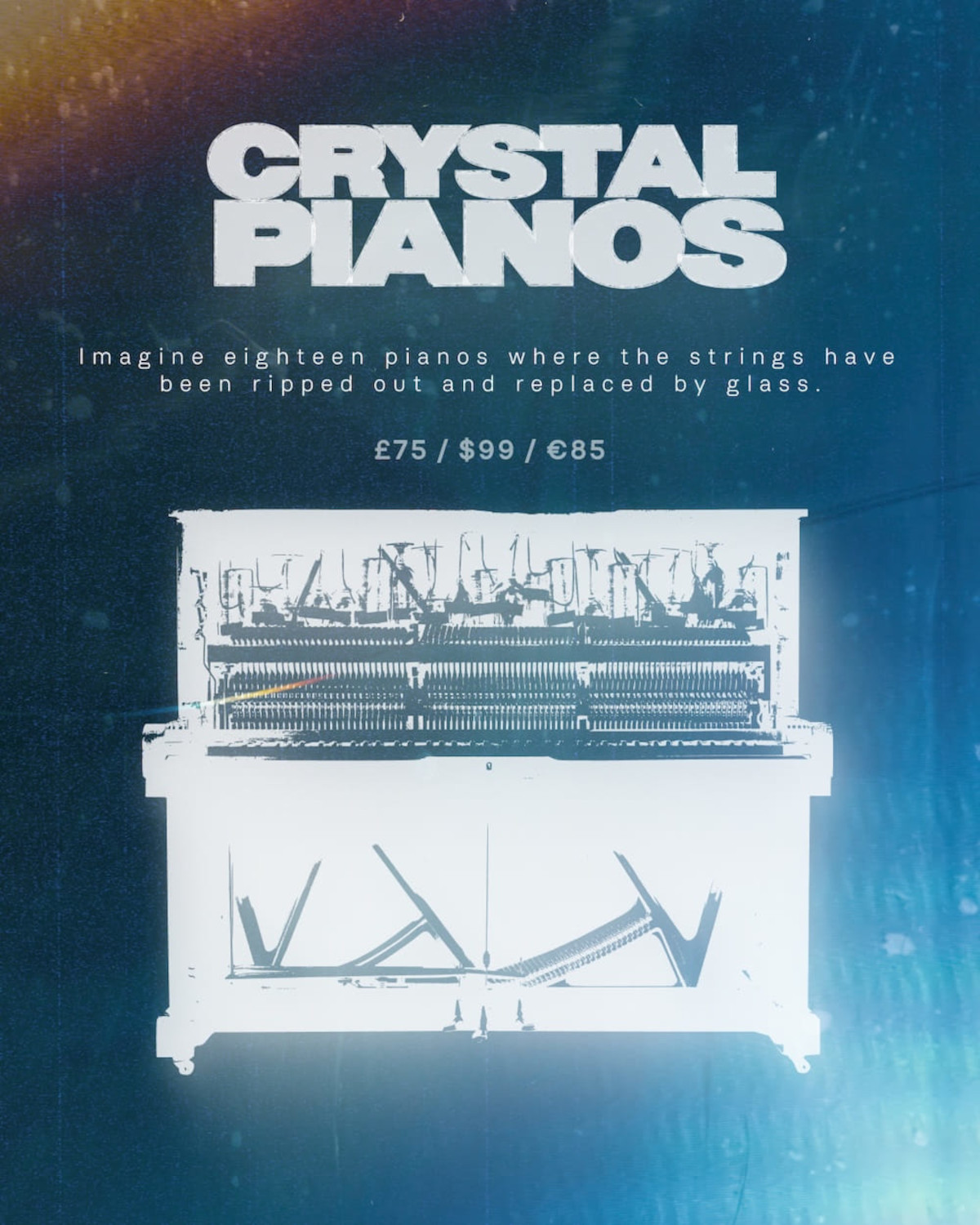
Be that as it may, those events all played a part in making CRYSTAL PIANOS what it is today — an invitation to imagine 18 pianos where the strings have been ripped out and replaced by glass as an innovative instrument. Indeed, each piece of glassware was handpicked for its unique sonic characteristics, ranging from intimate celeste-like tones all the way through to a chorus of shimmering glass; each offering provides users with five different playing styles: Standard Hits, Muted Hits, Tremolo Slow, Tremolo Fast, and Rubs (With Finger on Rim). It is also possible to control the sonic characteristic of each glass via The Crow Hill Company’s unique ‘partial mixer’ that enables users to tweak individual sonic components of the performances — namely, FUNDAMENTALS, the most audible music note or root; HARMONICS, the surrounding frequencies mapped into chromatic shepherd tones; and TRANSIENTS, the strike tone (that asserts the material characteristics of the instrument and therefore does not change, even if the pitch of the other partials does). Ultimately, users are free to create magical melodies that do not exhibit the sentimental ‘Potter-Effect’ of a celeste or glockenspiel, or orchestrate intricate contrapuntal tapestries or, indeed, oceans of rippling glass atmospheres to bring something new and unique to their music.
Clearly, Christian Henson’s road to The Crow Hill Company’s CRYSTAL PIANOS release has been a long and winding one — one that also represents something of a cathartic release for him personally: “I’m just absolutely delighted to have arrived at a point where I finally feel that I’ve created the stinky astronaut space piano thing-y. After 22 years, I can’t begin to tell you what an incredible sense of achievement that is, and that’s thanks to the amazing team that I work with who have persevered with this, because there’s been a lot of experimentation, back and forth — should we pitch the transients slightly, should the shepherd tones be louder or quieter, etc. I’ve taken them on a journey over the last six months, and I think they’re tired of hearing me say, ‘It’s taken me 22 years to get to my stinky astronaut space piano thing-y!’”
Featuring 18 individually selected pieces of glassware recorded at Gorbals Sound Recording Studios in Glasgow, UK with a multiple — Neumann KM 84, KM 184, and U 87 — microphone setup, CRYSTAL PIANOS is available to buy for £75.00 GBP/$99.00 USD/€85.00 EUR as a sample-based virtual instrument comprising over 30 GB of uncompressed audio (compressed loosely to ~13 GB) supporting AAX-, AU-, VST-, and VST3 plug-in formats for macOS 11 through to 15 (Apple Silicon and Intel compatible) and Windows 10 through to 11 with three different and individual controllable Partial Tones, five articulations, and four included — SUB BASS, DELAY, REVERB, and SPARKLE — effects from The Crow Hill Company here: https://thecrowhillcompany.com/tools/crystal-pianos/
For more in-depth information, including some superb-sounding audio demos from The Crow Hill Company co-founder Christian Henson himself, please visit the dedicated CRYSTAL PIANOS webpage here: https://thecrowhillcompany.com/tools/crystal-pianos/
CRYSTAL PIANOS installation and activation requires installation of The Crow Hill App — an easy-to-use app designed by the best in the business to provide seamless download, installation, integration, calibration, and organisation of The Crow Hill Company tools — available for free from here: https://thecrowhillcompany.com/crow-hill-app/
Become better acquainted with CRYSTAL PIANOS while watching The Crow Hill Company co-founder Christian Henson’s highly-informative introductory video here: https://youtu.be/AlhA6bHaE6w